Defining Pharmacy Deserts: How Methodology Shapes Pharmacy Access Policy

Nick Bernold
The Problem
Over the last 18 months, state legislatures nationwide have proposed solutions to dwindling "pharmacy access." Under that one banner, bills have grappled with two different problems, both worsened by the approximately 2,000 pharmacies that closed last year:
- Roughly 10% of Americans live far from any pharmacy at all - a true pharmacy desert.
- Another ~7% of Americans can reach exactly one pharmacy within a "reasonable" distance. If that "keystone" pharmacy closes, they're now in a desert.
The fixes aren't the same. Deserts call for adding supply (i.e. mail-order and mobile units). Keystone fragility means propping up a specific storefront through higher reimbursement or rules shielding it from competition. Yet legislatures often don't state which problem they're solving, then hand the tangle to overstretched agencies.
J2 Health helps state regulators implement pharmacy-access legislation, particularly identifying keystone pharmacies. This is urgent work: many are in financial distress, so finding them and getting them support they're entitled to is a race against the clock.
The Data
The most rigorous study of keystone pharmacies is Mathis, Berenbrok, Kahn et al. (2025). Rather than fix an arbitrary mileage cutoff, they define a "reasonable" distance relative to a local benchmark: a community is a pharmacy desert when travel time to its nearest pharmacy exceeds what it already spends reaching a supermarket - normalizing for vastly different population patterns nationwide. Mathis et al. ranks each area's fragility with a "vulnerability index": how many pharmacies must close before it tips into a desert (the last one standing being the "keystone").
However, most legislative proposals don't come close to this precision. Most agencies seem inclined to adopt a modified Medicare Part D "convenient access" standard ,defining access in plain mileage tiers: 90% of urban residents should live within 2 miles of a pharmacy, 90% of suburban residents within 5 miles, and 70% of rural within 15 miles. Given J2's deep experience with CMS and state time-and-distance calculations in network adequacy, we assessed the national picture under a CMS-inspired approach. Our main findings:
- At the highest level, the CMS-inspired and Mathis* approaches yield similar pictures of pharmacy access. Like Mathis, we found that: ~20% of Americans are underserved in pharmacy access, more Americans are in deserts than keystone areas, and independent pharmacies are disproportionately keystone pharmacies.
- At the state level, however, our results were meaningfully different. A CMS-aligned approach found greater issues in sparsely populated states like North Dakota, South Dakota, and Montana, where all drive distances are long; Mathis finds the relative pharmacy concentration is worst in New England states like New Hampshire, Vermont, and Maine.
- Results are highly sensitive to implementation. Different assumptions about what "reasonable" access means, how fast people drive, or which pharmacies count can change the number lacking pharmacy access almost twofold.
The Takeaways
In sum, these findings align with a challenge J2 has seen often. When legislation sets an important goal but leaves the methodology underspecified - as it often does - regulators make consequential choices with little guidance, and those choices can meaningfully impact outcomes.
We're excited to collaborate with states to turn laudable legislation into defensible standards that actually get support to caregivers — and ultimately patients - that need it most.
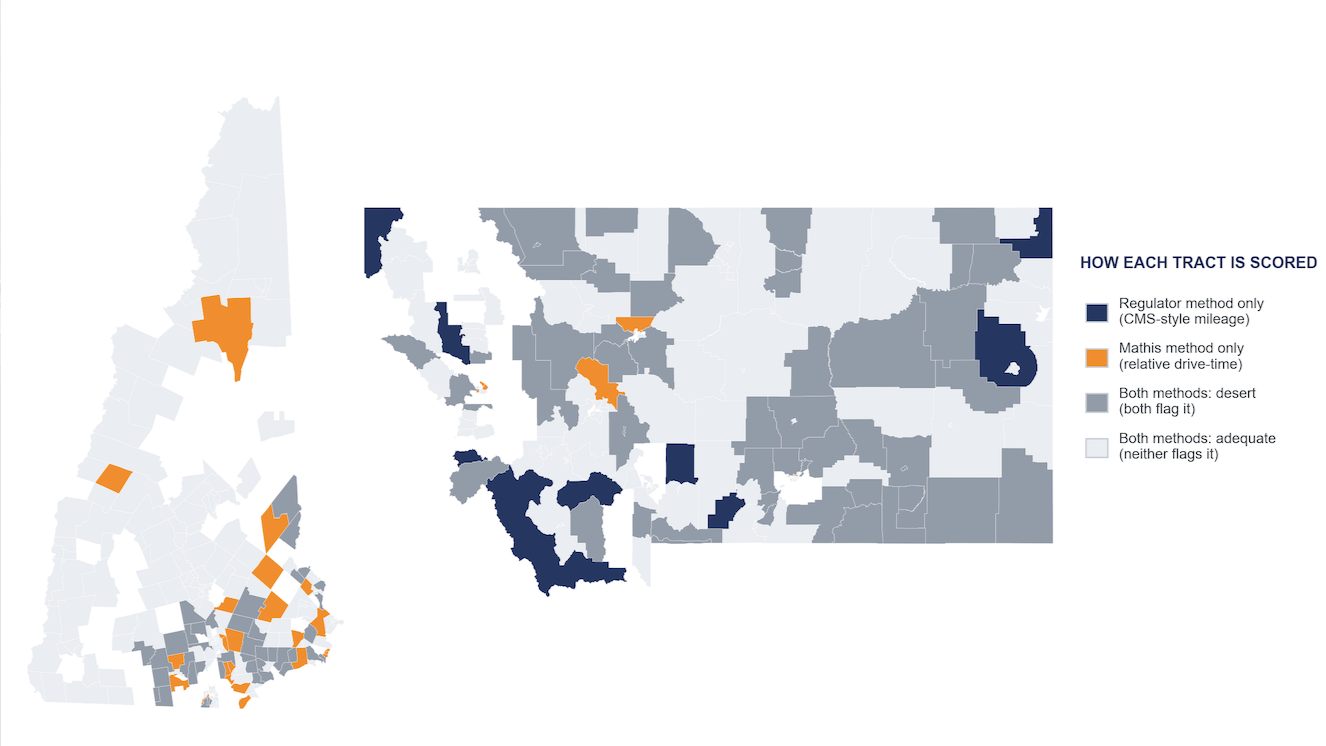
*Mathis research imperfectly recreated based on accessible datasets.


.jpg)